
Research
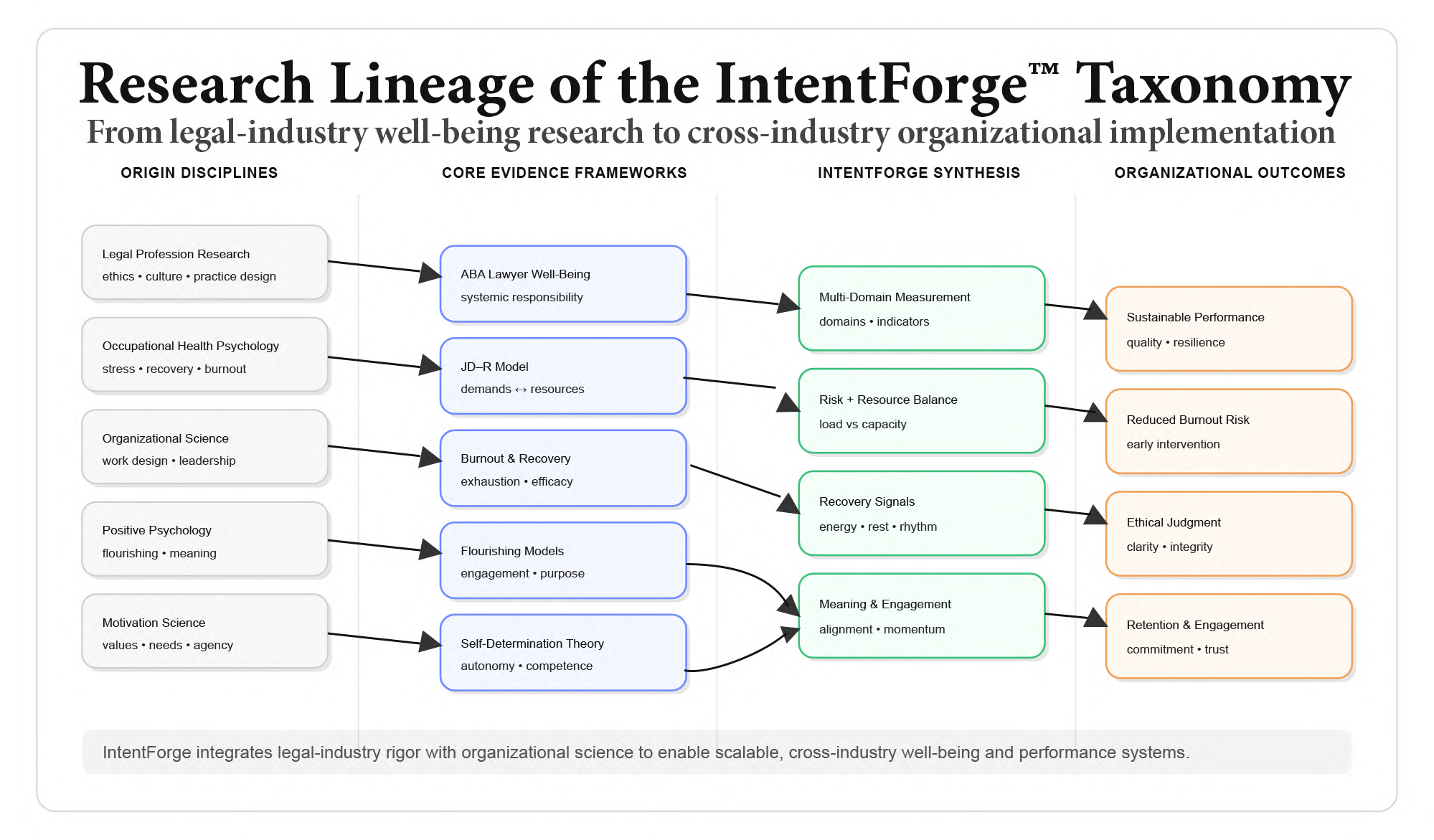
Research Lineage & Influences
The Evidence Foundation Behind the IntentForge™ Taxonomy
Why IntentForge Began in Law — and Why It Scales Across All Industries
The IntentForge Taxonomy was originally conceived in response to the legal profession’s well-documented well-being and performance crisis. Law provides a uniquely rigorous test environment: high cognitive load, chronic time pressure, adversarial dynamics, professional isolation, reputational risk, and ethical stakes.
However, the research makes one conclusion unmistakably clear: the underlying drivers of burnout, disengagement, and sustainable performance in law are not unique to law. They are structural, psychological, and organizational—and they appear across every knowledge-work and high-responsibility industry.
IntentForge therefore translates deep legal-industry research into a generalizable, organization-ready framework that can be implemented across sectors while retaining the rigor demanded by professions like law, medicine, finance, technology, and creative industries.
Foundational Legal-Industry Research
The ABA / National Task Force on Lawyer Well-Being
A central anchor for IntentForge is The Path to Lawyer Well-Being: Practical Recommendations for Positive Change, produced by the American Bar Association National Task Force on Lawyer Well-Being.
This report was pivotal because it reframed lawyer well-being as:
-
A systemic, organizational responsibility, not merely an individual resilience issue
-
An ethical and competence issue, directly tied to professional responsibility
-
A multi-dimensional construct, encompassing emotional, physical, social, intellectual, occupational, and spiritual well-being
How this shaped IntentForge:
The Task Force’s systems-level framing directly informed IntentForge’s insistence on organizational metrics, leadership accountability, and structural interventions—not just self-care recommendations.
Primary source:
-
The Path to Lawyer Well-Being: Practical Recommendations for Positive Change (ABA / National Task Force on Lawyer Well-Being)
“What Makes Lawyers Happy?” — Empirical Motivation Research
Another cornerstone is the empirical law-review research commonly cited as:
-
What Makes Lawyers Happy?
(Krieger & Sheldon)
This work demonstrated that:
-
Traditional success markers (income, prestige, rank) are poor predictors of lawyer happiness
-
Psychological needs such as autonomy, competence, relatedness, and values alignment strongly predict satisfaction and ethical functioning
-
Chronic misalignment between professional incentives and intrinsic motivation drives disengagement and distress
How this shaped IntentForge:
This research is a primary reason IntentForge explicitly measures meaning, purpose, autonomy, relational support, and intrinsic motivation—domains often ignored by conventional performance systems.
Cross-Industry Scientific Foundations
Occupational Stress & Burnout Research
IntentForge incorporates decades of occupational health psychology showing that burnout arises when job demands chronically exceed available resources and recovery capacity. This aligns with the World Health Organization’s classification of burnout as an occupational phenomenon, not a personal failing.
IntentForge contribution:
Burnout indicators are treated as signals, not endpoints—triggering earlier interventions at the demand, resource, and recovery layers.
Job Demands–Resources (JD-R) Model
The JD-R model explains how:
-
Job demands (workload, emotional strain, time pressure) increase burnout risk
-
Job resources (autonomy, support, clarity, feedback, fairness) buffer stress and drive engagement
IntentForge contribution:
The taxonomy explicitly balances risk exposure metrics with capacity-building metrics, enabling organizations to see where to intervene, not just what is broken.
Positive Psychology & Human Flourishing
IntentForge draws from positive psychology research that defines well-being as multi-component and developable, not simply the absence of distress. This includes constructs such as engagement, accomplishment, meaning, and social connection.
IntentForge contribution:
Performance is treated as something that emerges from well-being, not something that competes with it.
Self-Determination Theory (Motivation Quality)
Self-Determination Theory demonstrates that sustainable motivation depends on:
-
Autonomy (agency and choice)
-
Competence (mastery and effectiveness)
-
Relatedness (connection and belonging)
IntentForge contribution:
IntentForge distinguishes between output pressure and motivation quality, allowing organizations to improve performance without increasing burnout.
Engagement, Retention, and Organizational ROI
Long-running engagement research (including large-scale meta-analyses) shows consistent links between employee engagement and:
-
Productivity
-
Retention
-
Safety outcomes
-
Client satisfaction
-
Financial performance
IntentForge contribution:
This research enables IntentForge to bridge human well-being metrics with executive-level performance and ROI indicators.
Healthy Workplace & Psychosocial Risk Frameworks
Global healthy-workplace frameworks emphasize:
-
Psychosocial risk management
-
Shared responsibility between organizations and individuals
-
Culture, leadership, and work design as primary levers
IntentForge contribution:
The taxonomy is designed for implementation, not just assessment—supporting policy design, leadership training, and program governance.
How These Influences Converge in IntentForge
Across law-specific and cross-industry research, several conclusions consistently emerge:
-
Well-being and performance are structurally determined, not personality traits
-
Burnout is predictable and preventable
-
Engagement and ethics improve when work supports human psychological needs
-
Organizations need actionable, multi-domain measurement systems—not one-dimensional wellness scores
The IntentForge Taxonomy synthesizes these findings into a practical, scalable framework that began in the legal profession but is intentionally designed for organizations across all industries.